China’s shower enclosure market offers buyers a wide range of manufacturers, from established glass processors to specialists in complete sliding-door systems. This guide examines ten suppliers of Shower Sliding Door Glass and the details that can distinguish a dependable partner: glass consistency, edge finishing, hardware compatibility, customization, quality checks, and export support. A polished catalog is useful, but it cannot show how smoothly a door travels after years of daily use.
Design expert Charles Eames once said, “The details are not the details. They make the design.” His observation is not a glass specification, but it fits this product well. A quiet roller, a cleanly finished edge, and a handle that feels secure can matter as much as the glass itself. Look closely. Small choices count.
The suppliers are considered through practical questions: What glass options and thicknesses do they offer? Can they provide clear product specifications and consistent packaging? How do they handle samples, lead times, and communication when requirements change? These points help buyers compare more than price alone. Still, no ranking can replace a factory audit, sample inspection, or direct confirmation of project needs. Supplier capabilities can change, and a strong brochure is not proof of reliable production. Use this list as a starting point, then verify the details that matter to your project.
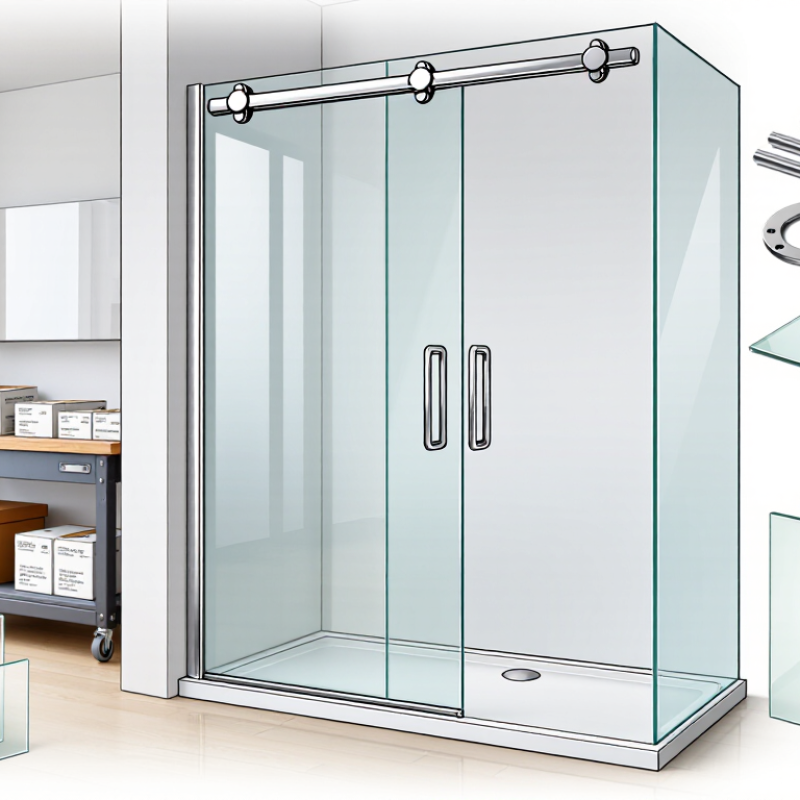
Shower sliding door glass is designed to move smoothly while containing water in a wet, frequently used space. Panels are commonly made from tempered safety glass, but the suitable thickness and configuration depend on the opening, hardware, and installation method. Check the supplier’s specifications rather than assuming one size fits every bathroom.
Clear glass keeps a compact room feeling open. Frosted or patterned glass offers more privacy, though it may show soap residue differently. Applications range from alcove showers to corner enclosures, where sliding panels can save space otherwise needed for a swinging door.
Measure the opening at several points; walls are not always perfectly plumb. Details matter. The weak point is often not the glass itself, but a mismatch between the opening, rollers, and seals.
Smooth-running rollers and well-fitted seals help limit leaks, but no sliding door should be treated as completely watertight. Leave enough access for cleaning the track, where hair and mineral deposits can collect. It is easy to overlook that narrow channel until the door starts to drag. Proper installation and routine checks help maintain safe movement over time.
When evaluating Chinese suppliers of shower sliding door glass, start with the glass itself. Ask for the specified thickness, glass type, and heat-treatment records for the product you plan to order. Check whether each panel can be traced to a production batch. Ask for records. A reliable supplier should explain how it checks dimensions, flatness, and edge polishing, not just show a finished sample.
Then examine how the glass works with the door system. Sliding panels need accurately positioned holes and smooth, consistent edges; small deviations can cause poor alignment or uneven movement. Request drawings and confirm tolerances before approving production. Review samples in natural light, where chips, haze, or uneven finishes may be easier to spot. Small details matter. Ask how the supplier protects corners and separates panels during packing, and request photos of a packed shipment.
Factory capacity and communication also deserve attention. Discuss monthly output, lead times, inspection steps, and how defects are documented and handled. A video call or factory visit can help verify equipment and workflow, but it cannot replace written specifications and sample checks. A polished sample can hide variation between batches. I would not treat one successful order as proof of consistent quality; compare later production records and inspect incoming goods against the agreed criteria.
Common shower-door glass thickness options (6, 8, and 10 mm) provide a practical comparison point when reviewing supplier product ranges. Availability varies by product, market, and applicable building requirements; thickness alone does not establish safety or quality.
China’s supplier landscape includes glass processors, hardware makers, and integrated shower-enclosure manufacturers. Their capabilities differ. Some focus on tempered panels, while others combine glass cutting, edge polishing, drilling, and frame assembly. China’s National Bureau of Statistics reported 969.01 million weight cases of flat-glass production in 2023. This figure describes the wider glass industry, not shower-door output, but it shows the scale behind local sourcing.
A useful supplier profile should examine more than catalogue size. Check glass thickness options, edge finishes, roller smoothness, and whether test records match the supplied specification. Ask how panels are protected during transport; a chipped corner can spoil an otherwise sound installation. Details matter. The strongest candidates usually provide consistent dimensions, documented quality checks, and clear answers about replacement parts. Production capacity alone is not enough.
The ten profiles can therefore be compared by product range, customization, manufacturing controls, delivery capability, and export experience, without assuming that one factory suits every project. Public data rarely separates shower sliding-door glass from other flat-glass products, so capacity claims need direct verification. This part is easy to overlook. Request recent inspection records and a sample specification before comparing quotations. A low price may reflect thinner hardware or fewer finish options, though that is not always the case.
When comparing China’s leading shower sliding door glass suppliers, look beyond clear photographs. Ask for glass thickness, edge-finishing details, hardware materials, and documented safety tests. Check whether rollers move smoothly under load and whether frame joints resist water entry. Small defects matter. A chipped edge or loose handle can undermine an otherwise attractive enclosure. Request sample panels or inspection records where practical, and confirm that test documents match the offered specification.
Design and customization should be judged against real bathroom conditions. Measure the opening, wall plumb, and clearance for nearby fixtures before choosing sliding or corner configurations. Suppliers may offer patterned, low-iron, frosted, or tinted glass, plus adjustable tracks and custom finishes. Clarify tolerances, minimum order quantities, replacement-part availability, and lead times in writing. UNEP and GlobalABC’s 2023 Global Status Report says buildings and construction accounted for 37% of global energy- and process-related CO₂ emissions in 2022. That figure is sector-wide, not specific to shower doors, but it supports asking about recycled content, packaging, and product lifespan. A glossy catalog can hide practical limits; I would compare actual samples, not just renderings.
China Top 10 Shower Sliding Door Glass Suppliers
Verifying Suppliers and Planning the Sourcing Process
A supplier shortlist is only a starting point. Before requesting prices, define the door size, glass thickness, edge finish, hardware, and expected order quantity. Send the same specification sheet to every candidate. This makes quotations easier to compare and helps reveal missing details. A low price can look attractive. It may not include packaging, samples, or replacement parts.
Ask suppliers for recent product photos, inspection records, and references for similar projects. Request a sample when practical, then check its dimensions, surface, and edge quality under good lighting. Confirm production capacity and lead time in writing. Ask how the supplier handles scratches, breakage, or inconsistent measurements. A spreadsheet is useful, but it can create false confidence; details still need checking. I would leave room for one more review.
Tips: Keep one file for drawings, quotes, sample notes, and contact records. Compare like with like. Clarify who pays for sample shipping and how goods are packed. Small omissions matter. If a reply feels vague, ask one specific follow-up question before moving forward.
How to use this table: This is a supplier-verification and sourcing checklist, not a ranking of named companies. Requirements vary by destination market, product design, and project specifications.
| No. | Evaluation Dimension | What to Verify | Practical Sourcing Action |
|---|---|---|---|
| 1 | Product and Factory Scope | Confirm whether the supplier manufactures glass, fabricates finished shower panels, assembles complete door systems, or acts as a trading company. | Request a process flow, facility address, product catalogue, and a live video walkthrough. Match the stated production scope to your order. |
| 2 | Glass Specifications | Check the specified glass type, thickness, dimensions, edge finish, holes, notches, and any coating or pattern. Common shower-door glass thicknesses include 6 mm, 8 mm, and 10 mm, but suitability depends on the design and applicable requirements. | Send a dimensioned drawing and written specification. Approve a production sample or first-article inspection before authorizing the full order. |
| 3 | Safety-Glazing Compliance | Identify the regulations and standards required in the destination market. Examples include ANSI Z97.1 and U.S. CPSC 16 CFR Part 1201 for applicable safety glazing, and EN 12150 for thermally toughened soda lime silicate safety glass in relevant European markets. | Ask for reports or certificates that match the exact glass construction and intended market. Verify the issuing laboratory, report scope, product details, and validity directly where possible. |
| 4 | Quality Management and Traceability | Check whether any quality-management certificate is current and applies to the manufacturing site. ISO 9001 relates to a quality-management system; it is not, by itself, product safety certification. | Request the certificate and verify its scope, site, and status with the certification body. Ask how batches, inspection results, and nonconforming products are recorded. |
| 5 | Hardware and System Compatibility | Confirm roller, track, handle, seal, and fastener materials and finishes, as well as load capacity and compatibility with the specified glass thickness and door layout. | Request a complete bill of materials, installation drawings, and a representative hardware sample. Check that replacement parts can be identified by specification rather than appearance alone. |
| 6 | Production and Inspection Controls | Review how the supplier controls cutting, edgework, drilling, tempering, assembly, and final inspection. Clarify inspection criteria for dimensions, appearance, hardware operation, and packaging. | Agree on written acceptance criteria before production. Consider an independent pre-shipment inspection for the first order or other high-risk shipments. |
| 7 | Packaging and Transit Protection | Check how glass edges and surfaces are protected, how panels are separated and restrained, and whether the package is suitable for the chosen transport and handling conditions. | Request packaging photos and a packing specification. Confirm package dimensions, gross weight, marking, and responsibility for damage reporting before shipment. |
| 8 | Commercial Terms and Cost | Compare quotations on the same specification, quantity, packaging, payment terms, and delivery basis. Incoterms® 2020 rules define certain buyer and seller responsibilities, costs, and risks; they do not replace the sales contract. | Request a line-item quotation and state the agreed Incoterms® 2020 rule and named place or port. Confirm tooling, sample, inspection, and replacement costs in writing. |
| 9 | Capacity and Delivery Planning | Check the supplier's available production capacity, order acceptance process, raw-material planning, and quoted production and shipping schedules. Lead times and minimum order quantities vary by supplier and specification. | Ask for a dated production schedule with approval milestones. Confirm how schedule changes are communicated and avoid relying on an undated or verbal lead-time estimate. |
| 10 | Sampling, Communication, and After-Sales Support | Assess response clarity, drawing revision control, sample approval procedures, complaint handling, and the availability of technical documents and replacement components. | Use a written request-for-quotation checklist, maintain an approved document revision, and agree on a contact, response process, and defect-resolution procedure before placing the order. |